Knowing Every Room Before You Enter It
Our controller learns how rooms behave once, in simulation. We follow it into a flat it's never seen, perceiving the place alongside Alex as he moves in.
Walk into a room you've never been in and you already know some things about it. A radiator under the window will warm the near side first. Opening that window on a cold day will pull the temperature down within minutes. You've never been in this room, but you've been in enough rooms to know how rooms behave.
Most building controllers don't have that knowledge. Each one learns its building from scratch, from that building's own measurements, and knows nothing about the next building along.
Our team has been working on what we call amortising physics: learning how environments behave once, in a way that holds in rooms our controller has never entered. To make it concrete, this article follows Alex, an agent who moves into a new apartment and explores it the way anyone does when they arrive somewhere new. As he explores, our controller perceives the flat alongside him, through every sensor in every room.
Alex moves in
It's seven in the morning in a one-bedroom flat Alex has never seen. Nobody's given him a floor plan, a heating survey or a list of what's plugged in where. He has the room sensors, the weather outside and the devices he can switch: a thermostat in the living room, an air conditioner in the bedroom, a window in each room and the lights. What Alex feels, our controller reads: each room's warmth, air, humidity, light and noise, every fifteen minutes.
Someone moving in would already have a rough idea what to expect. The bedroom faces east, so the sun will warm it early and leave it cold by mid-afternoon. The living-room radiator will take twenty minutes to be felt, and some of its heat will leak through the wall into the hallway. Opening the kitchen window on a January morning will drop the temperature fast, and it'll keep dropping until someone shuts it.
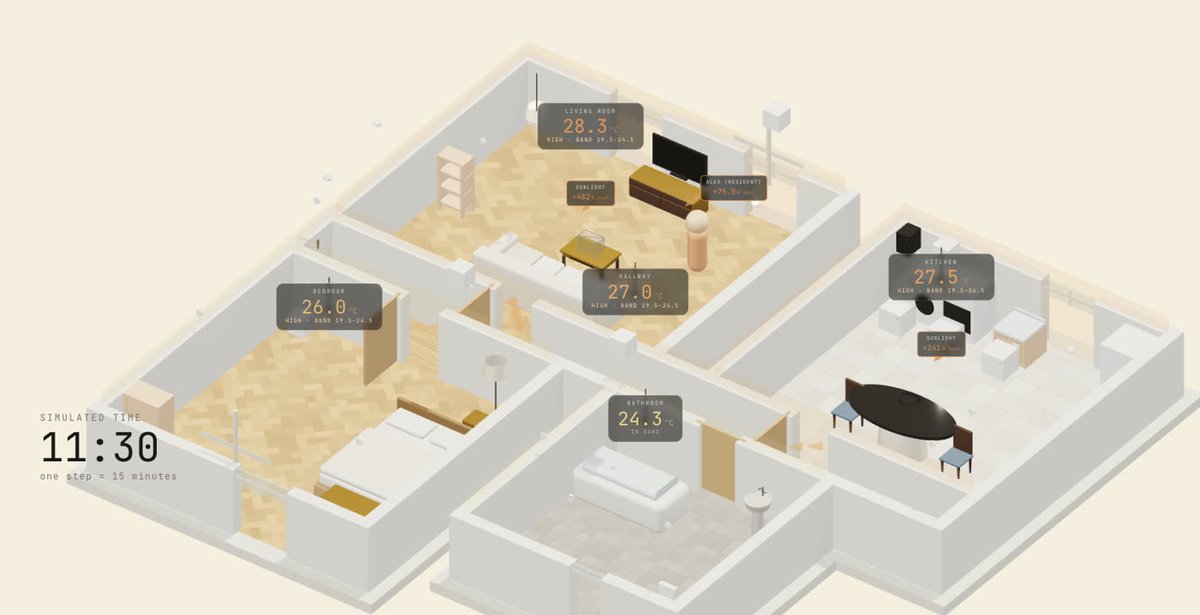
Alex's first morning in a flat from our simulator. He's in the living room, and every room reports its temperature.
Why a controller normally starts from zero
To control a building well you need to know how it responds: how fast a room warms when the heating comes on, how much heat a window lets out, how one room pulls on the room next door. The usual way to get that is to have an engineer build a model of the building from its own sensor data. Learning it on site instead, with reinforcement learning or a model-predictive controller, takes a long time in every new building.
Both approaches also trust the building's records. A cooler that's quietly stopped cooling, a window painted shut, a portable heater nobody listed: a model built from the records inherits every one of those mistakes before Alex has even moved in. They perceive the building as it was written down, which isn't always the building Alex lives in.
Learning what it knows
We borrowed an idea from robotics. Robots that practise in simulated environments rehearse millions of times at no risk, then act in places they were never trained. We did the same for the environment itself, building a simulator that generates apartments with rooms, walls, windows, weather, devices and an occupant, Alex, who reacts to discomfort.
From those simulated apartments our controller learned what each device does to each reading, in its own room and in the rooms around it. A thermostat warms its own room a lot and the room through the wall a little. An open window swaps heat with the outdoors. A light adds a touch of warmth.
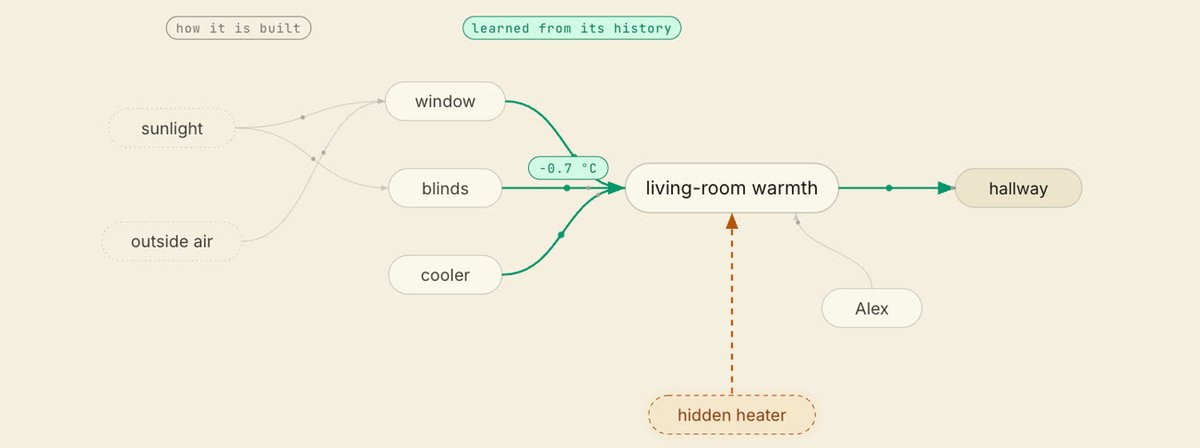
What the controller knows about one room. Some links come from how the flat is built, others from its history. Alex is part of the picture, and a hidden heater shows up as warmth nothing on the network can explain.
It also learned a sense of where each room's temperature is heading over the next few hours, from the same simulated days. When Alex arrives in a new apartment, the only thing left to work out is a small correction per room, so the general expectation fits this room's habits. It's the same adjustment you make in your first week in a new flat: the bedroom's colder than you expected, so you learn to leave the door open. For our controller, perceiving a room means comparing what it reads with what it expected. The gap is where it learns.
Every fifteen minutes our controller runs each option through the forecast, estimates what it would do, and picks the best. It never consults a physics model while it decides, and it never calls back to the simulator it trained in. That's what we mean by amortising physics. The physics work is done once, in simulation, then spread across every environment Alex walks into.
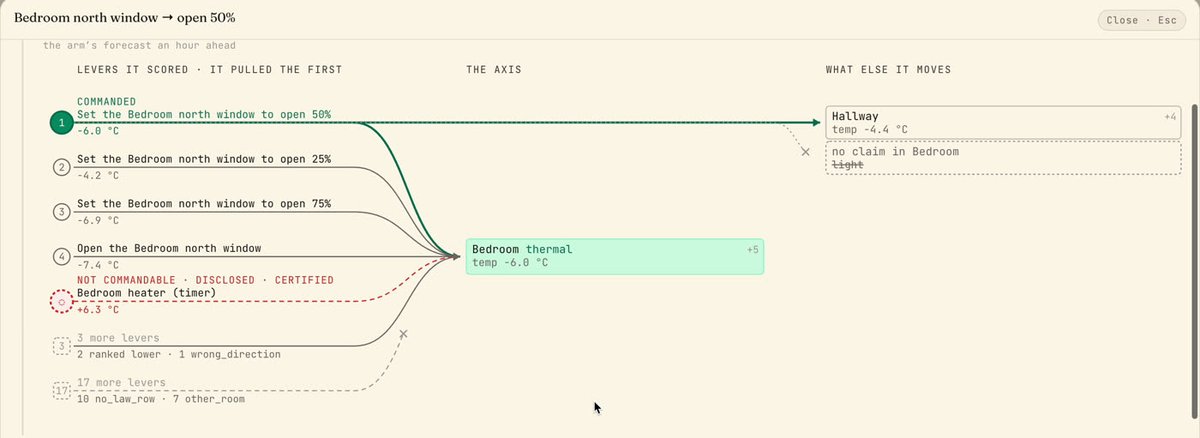
One of the controller's decisions in the platform. The bedroom's forecast to overheat, so it weighs 24 levers and opens the north window halfway. A heater on a timer is flagged as something it can't switch.
A day in the flat
Back to the morning. The bedroom's a little cold and Alex is about to wake. The controller perceives the same chill as a reading drifting below the comfortable band, and it can see where that reading's heading. The forecast says the room will warm by itself once the sun comes round, though not for another hour. The controller weighs its options. Heating with the bedroom air conditioner would cost energy and overshoot once the sun arrives. The living-room thermostat would reach the bedroom slowly, through the wall. It could also do nothing. It nudges the thermostat, because the table says the warmth will come through the wall at about the time Alex gets up. Then it leaves that decision alone instead of second-guessing it every few minutes.
At midday the living room's overheating and Alex opens a window by hand. The controller sees the temperature drop faster than it expected, adjusts its sense of the room and leaves the window be. Nobody has to tell it the open window's doing the cooling. The reading tells it.
At 4pm the kitchen's warm and the air outside is cool, so the controller opens the kitchen window a third of the way and runs nothing. At 8pm Alex comes home to a comfortable living room, and the controller does nothing at all.
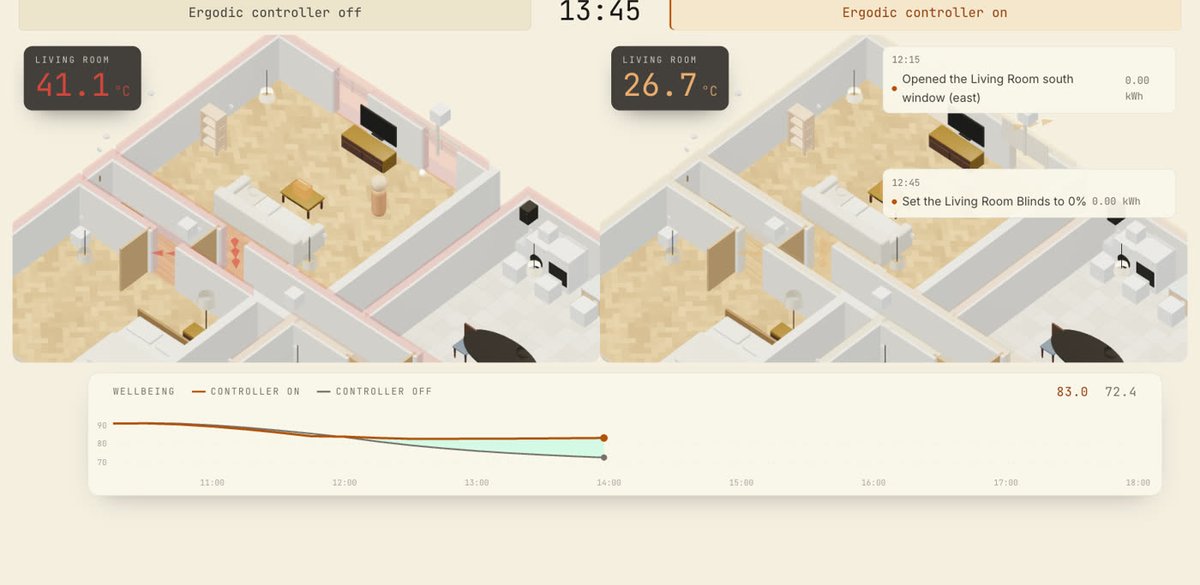
A hot afternoon in another flat, run twice. With no controller the living room reaches 41.1 °C by 13:45. With the controller it's 26.7 °C, after it opened the south window and lowered the blinds.
How well it works
The real test is how the controller does in apartments it's never seen.
We ran it on 600 apartments that were never used in training, each in four kinds of weather. Compared with leaving the flat to its occupant, it kept people comfortable for about three more hours a day, and did better on nearly every day. It also beat the methods a building engineer would normally reach for, a controller trained by trial and error and a controller built from the building's own data, all run on the same apartments.
Then we pushed on how general the knowledge is. On 200 apartments whose walls and windows were deliberately varied by up to 30%, it did as well as a version of itself handed each apartment's true physics. We also took the same approach, retrained it on our simulator alone and dropped it onto a public benchmark built by other researchers: a single-family house with a heat pump that shares nothing with our apartments. In the coldest week of the year it beat the best published controller on that benchmark on comfort and energy. In a milder week it still used about 15% less energy than that controller, and beat the benchmark's own thermostat on comfort and energy alike.
Knowing the person in the room
Millions of people already wear devices that could tell the controller how they're doing, from Oura to Ultrahuman to the Apple Watch, tracking skin temperature, heart rate, movement and sleep through the night. The phone they pair with knows which room its owner is in. To the controller, a wearable is one more device whose readings happen to bear on comfort and wellbeing. It would let the controller perceive Alex as well as the room he's in. What it could do with those readings is an open question, and one we keep coming back to.
The obvious possibility is that comfort stops being a number on a thermostat and becomes personal. Someone comes home from a run with their skin temperature up, and the room that felt right an hour ago is now too warm. Later they fall asleep, their body temperature drops, and the same room is now too cool. A ring that sees a restless night might be telling the controller the bedroom's wrong even when the thermostat says it's fine. The same could hold for someone who always runs cold, or someone recovering from illness. The controller already judges every action by how comfortable it expects the person to be, so a personal target changes what it listens to. How it thinks stays the same.
A wearable also gives a reading from the person's side. If the room looks comfortable and the person doesn't, something's off. It might be a sensor, a need the room sensors can't see, or a device that isn't on the records. The controller already untangles questions like this when it works out that a cooler has died, and the same instinct might carry over.
The one we think matters most is reaching people who can't adjust the room themselves. In a care home many residents can't change a thermostat or open a window, and discomfort often goes unreported. A ring or a watch could be how that discomfort reaches something that can act on it. Hospital wards and people living alone raise the same question.
Knowing every device in the home
Now put the controller behind the smart-home hub. Most connected homes today are a collection of devices that each talk to their own app, joined by a hub that passes messages between them. Automations are rules the resident writes: if the temperature falls below 19 degrees, turn on the heater. The hub passes readings along without perceiving what they mean, so it has no idea how one device affects another. It doesn't know the heater in the hallway is also warming the bedroom, or that the open window is undoing the air conditioner.
The controller could weigh every connected device at once, open a window when the outdoor air will do the cooler's job, and leave a device alone once it's made a decision instead of flicking it on and off. For the resident, the home keeps working when the internet doesn't, and the knowledge of how rooms behave ships in the box from day one.
It also makes fault-spotting something people would pay for. A hub that can say the living-room cooler has stopped cooling, or that a heater's running in the bedroom that isn't on the list, does something no smart home does today. It's perceiving the fault before anyone reports it. In our tests the controller named a dead cooler in 76 of 111 apartments without a single false alarm, and found a hidden 1,500 W heater in 103 of 120.
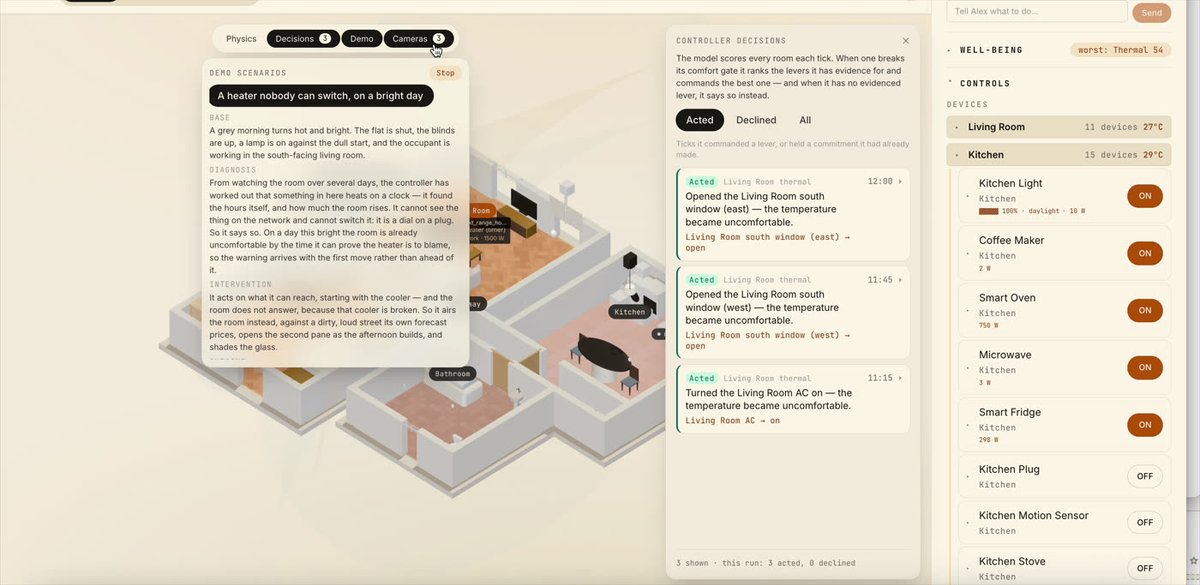
A heater on a plug nobody can switch. The controller works out the heater's to blame, finds the cooler doesn't answer, and airs the room instead.
Hospitals, universities and other environments
We placed Alex in an apartment, but nothing in how the controller works is tied to a home. It needs rooms, devices that change them, sensors that read them, and a simulator that can generate many varied examples to learn from.
A hospital ward is occupied around the clock, and some of its rooms have strict rules. An operating theatre or an isolation room has to keep its air flowing in a set direction at a set rate. The comfortable range becomes hard limits that must never be crossed, and the devices include things an apartment lacks, like air-handling units and dampers. Fault-spotting matters more here than anywhere. A damper that doesn't move when asked is the same kind of fault as the dead cooler, but in an isolation room it can break the air pressure the room depends on.
A care home is where the wearable story matters most. Residents often can't act on their own discomfort, and staff can't be in every room. Here the worst day counts for more than the average, so the controller would be judged on its bad days, and its weakest weather, a heatwave, would need its own standard.
A university campus is where learning the physics once saves the most work. A campus is dozens of buildings of different ages and types, run by one estates team, and today each building would need its own engineer-built model. The timetable, which says when a lecture theatre goes from empty to full, would become one of the controller's biggest inputs.
Each of these needs its own simulator, its own devices, a model of the people or processes inside, and a clear statement of what must never happen.
Any environment, before you enter it
Our controller can learn how buildings behave once, in simulation, and carry that knowledge into buildings it's never seen, including one built by other people, with no physics model in the loop. Wearables, connected homes and hospitals don't change that. They change what the controller can perceive: what counts as a reading and what counts as a device.
What ties them together is that the physics is learned once and reused, so Alex, or any agent or person who moves in, stays comfortable from the first day.
Run the decision before you commit to it.
Bring a decision. We'll discuss how to model it and what data a simulation would need.
Talk To An Expert